Introduction
Something fundamental has changed in how people search for information, products, and services. For the past two decades, the pattern was predictable: open Google, type a query, scan blue links, click through to websites.
Not anymore.
Today, millions of people are skipping traditional search engines entirely. Instead, they're asking ChatGPT, Claude, Perplexity, or their favorite AI assistant. They're getting direct answers, personalized recommendations, and conversational guidance - without ever visiting a brand's website.
This isn't a trend. It's a paradigm shift. And if your brand isn't prepared, you're about to become invisible to a growing segment of high-intent consumers.
The Old Search Funnel Is Breaking
The traditional search funnel looked like this:
Traditional Funnel:
- User has question/need
- Opens Google
- Types search query
- Scans search results (SERP)
- Clicks on website
- Browses website
- Makes decision/purchase
Brands optimized for this funnel with SEO, paid search ads, landing pages, and conversion optimization. The goal was simple: rank high, get clicks, convert visitors.
But AI assistants are collapsing this funnel.
The New AI-First Search Funnel
Here's what's actually happening now:
AI-First Funnel:
- User has question/need
- Opens AI assistant (ChatGPT, Claude, etc.)
- Asks conversational question
- Gets direct answer + recommendations
- Makes decision (often without leaving chat)
Notice what's missing? Your website. Your SERP ranking. Your carefully crafted landing pages.
The AI assistant has become the intermediary - the new gatekeeper between consumers and brands.
Why People Prefer AI-First Search
The shift isn't random. AI assistants offer genuine advantages over traditional search:
1. No Link Scanning Required
Traditional search forces you to evaluate 10 blue links, guess which might have your answer, and click through multiple sites.
AI search gives you the answer directly, synthesized from multiple sources.
2. Conversational Refinement
With Google, refining your search means typing a new query and starting over.
With AI, you can ask follow-up questions naturally:
- "What about options under $500?"
- "Which one is best for beginners?"
- "Are there any with free shipping?"
3. Personalized Context
AI assistants remember your conversation context. They know you mentioned you're a student, or that you prefer eco-friendly products, or that you're shopping for a gift.
Traditional search has no memory. Every query is isolated.
4. Decision Support, Not Just Information
Search engines give you information. AI assistants help you make decisions.
They compare options, explain trade-offs, and guide you toward the best choice for your specific situation.
The Data: How Big Is This Shift?
The numbers are striking:
Usage Growth
- ChatGPT reached 100M users in 2 months (fastest-growing app in history)
- Perplexity serves 500M+ searches per month
- Google's AI Overviews now appear on 15%+ of searches
- 40% of Gen Z prefers AI assistants over traditional search (2024 study)
Search Behavior Changes
- 60% of ChatGPT users report using traditional search less frequently
- Average AI chat session: 8-12 minutes (vs. 1-2 minutes on Google)
- 35% of product research now starts in AI assistants (up from 5% in 2023)
Intent Signals
People aren't just asking trivial questions. They're using AI for high-intent searches:
- "Best CRM for small business under $100/month"
- "Compare iPhone 15 Pro vs Samsung S24 Ultra for photography"
- "Find me a hotel in Tokyo near Shibuya, budget-friendly, good for couples"
These are buying signals - and they're happening inside AI assistants, not on your website.
What This Means for Brands
If consumers are asking AI instead of searching Google, brands face three critical challenges:
Challenge #1: Invisibility
If your brand isn't mentioned by AI assistants, you don't exist in this new funnel.
Unlike Google, where you can pay for ads or optimize for rankings, AI assistants make recommendations based on their training data, real-time web access, and contextual relevance.
You can't buy your way to the top of a ChatGPT recommendation.
Challenge #2: Loss of Control
On your website, you control the narrative, the design, the conversion path.
In an AI conversation, you have no control. The AI decides:
- Whether to mention your brand
- How to describe your product
- Which competitors to compare you against
- What information to highlight
Challenge #3: Attribution Breakdown
Traditional analytics track the user journey: search → click → browse → convert.
With AI-first search, users might:
- Research entirely in chat
- Get a recommendation
- Go directly to checkout (or not visit your site at all)
Your analytics show a "direct" visit with no attribution. You have no idea the AI assistant sent them.
What Brands Should Do About It
This isn't a problem to solve - it's a new reality to adapt to. Here's how forward-thinking brands are responding:
Strategy #1: Optimize for AI Discoverability
Just as you optimized for Google SEO, you now need to optimize for AI recommendations.
How to do it:
- Structured data: Use schema markup so AI can easily parse your product info
- Clear, factual content: AI assistants prefer authoritative, well-structured information
- Public presence: Maintain active profiles on platforms AI assistants crawl (Reddit, Quora, industry forums)
- Reviews & mentions: Encourage authentic reviews and discussions about your brand
Example:
A hotel chain ensures every property has:
- Detailed structured data (location, amenities, pricing)
- Up-to-date information on Google Business Profile
- Active presence on TripAdvisor and travel forums
- Clear, factual descriptions (not marketing fluff)
Result: When users ask ChatGPT for hotel recommendations, their properties appear frequently.
Strategy #2: Become a Recommended Source
AI assistants cite sources. Be one of them.
How to do it:
- Create authoritative guides: Comprehensive, unbiased content that AI can reference
- Publish research & data: Original studies, surveys, and statistics
- Expert positioning: Establish team members as industry experts
- Open knowledge sharing: Don't gate everything - let AI assistants access and cite your expertise
Example:
A SaaS company publishes an annual "State of the Industry" report with original data. AI assistants frequently cite this report when answering questions about the industry, driving brand awareness and authority.
Strategy #3: Enable AI-Friendly Transactions
Make it easy for AI-referred customers to convert.
How to do it:
- Direct product links: Ensure every product has a clean, shareable URL
- Simplified checkout: Reduce friction for users coming from AI recommendations
- API access: Consider offering APIs that AI assistants can query directly
- Clear pricing: No "contact us for pricing" - AI assistants prefer transparent information
Example:
An e-commerce brand creates a /ai landing page specifically for AI-referred traffic, with:
- Streamlined product selection
- Clear pricing and specs
- One-click checkout
- No popups or distractions
Strategy #4: Participate in Conversational Commerce
The future isn't just AI recommendations - it's transactions happening inside conversations.
How to do it:
- Conversational AI integration: Build or integrate with AI assistants
- Affiliate partnerships: Work with AI platforms that offer sponsored recommendations
- Chatbot commerce: Enable purchases directly in chat interfaces
- Voice commerce: Optimize for voice-based AI assistants (Alexa, Siri, Google Assistant)
Example:
A travel booking platform integrates with Perplexity's shopping features, allowing users to:
- Search for flights in Perplexity
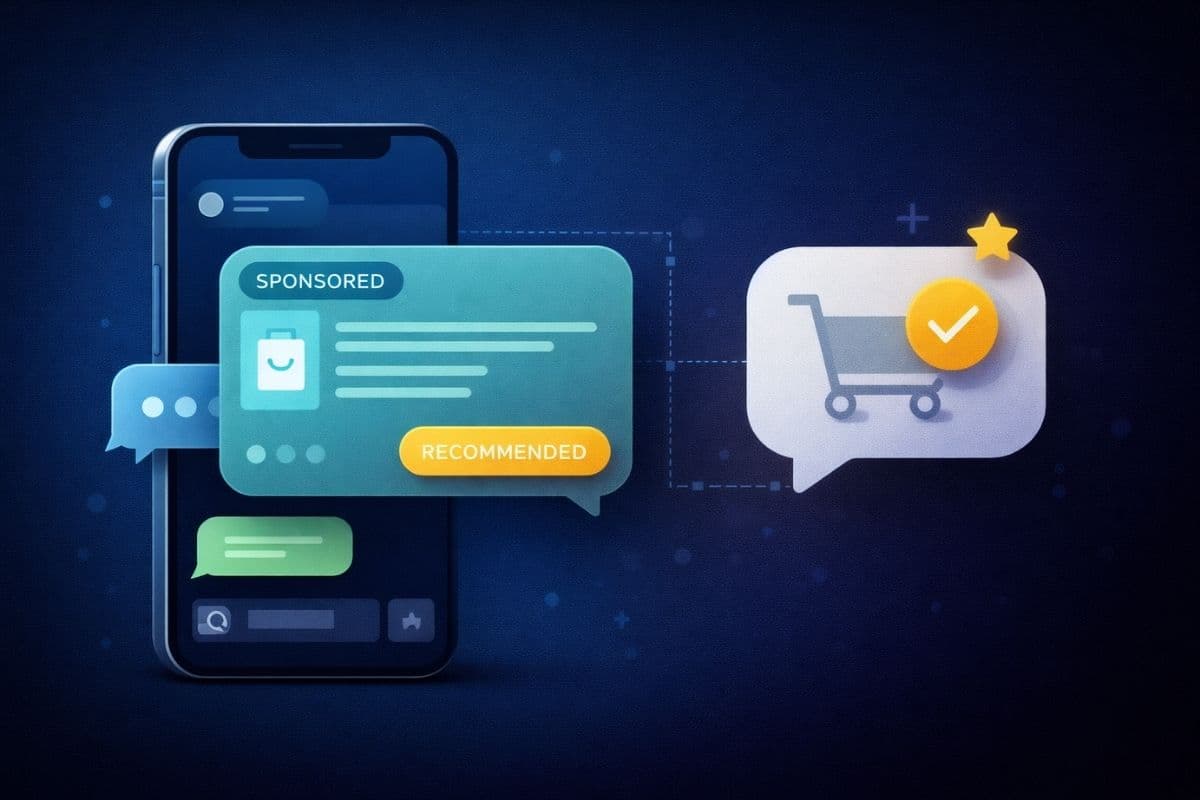
- See sponsored recommendations
- Book directly without leaving the chat
Strategy #5: Track AI-Driven Traffic
You can't optimize what you don't measure.
How to do it:
- UTM parameters: Use tracking codes for AI-specific campaigns
- Referrer analysis: Monitor traffic from AI assistant domains
- Survey users: Ask "How did you hear about us?" with AI options
- Attribution modeling: Build models that account for AI-assisted discovery
Example:
A DTC brand adds a post-purchase survey question: "Did an AI assistant recommend us?" They discover 18% of customers used AI in their research - a segment they were completely blind to before.
The Opportunity: Conversational Monetization
Here's the exciting part: This shift creates new monetization opportunities.
For Publishers & AI App Builders
If you're building conversational AI experiences, you can monetize through:
- Contextual recommendations: Show relevant product suggestions based on conversation
- Affiliate partnerships: Earn commissions on purchases driven by your AI
- Sponsored answers: Integrate brand partnerships into responses (transparently)
This is where Sponsy comes in. We help AI app publishers monetize conversations through privacy-safe, contextually relevant recommendations - without storing transcripts or compromising user trust.
For Brands
Conversational commerce is the new frontier:
- Higher intent: Users in AI conversations are often further down the funnel
- Better targeting: Recommendations based on real-time context, not historical data
- Native integration: Feels like helpful suggestions, not intrusive ads
Case Study: How One Brand Adapted
The Brand: A mid-sized outdoor gear retailer
The Problem: Noticed declining organic search traffic despite maintaining SEO rankings. Couldn't explain where customers were coming from.
The Investigation: Added a survey asking about AI usage. Discovered 22% of customers had used ChatGPT or similar tools to research products before purchasing.
The Strategy:
- Created comprehensive, unbiased buying guides for each product category
- Ensured all product pages had detailed, structured specifications
- Encouraged customers to leave detailed reviews
- Partnered with AI-powered shopping assistants for sponsored placements
- Built a custom GPT for outdoor gear recommendations
The Results (6 months later):
- 35% increase in "direct" traffic (likely AI-referred)
- Brand mentioned in 40% of AI assistant outdoor gear recommendations (measured via testing)
- 15% revenue growth from AI-attributed customers
- Higher AOV from AI-referred customers ($180 vs. $145 average)
Looking Ahead: The Next 3 Years
This is just the beginning. Here's what's coming:
2026: AI-First Becomes Mainstream
- 50%+ of product research starts with AI assistants
- Major brands launch AI-specific marketing strategies
- "AI SEO" becomes a standard practice
2027: Conversational Commerce Scales
- Purchases happen directly in AI conversations
- Voice commerce becomes significant revenue channel
- Traditional e-commerce sites become "fulfillment backends"
2028: The Post-Website Era
- Many consumers never visit brand websites
- AI assistants handle entire customer journey
- Brands compete for "AI mindshare" rather than "search rankings"
Conclusion: Adapt or Become Invisible
The search funnel is being rewritten. AI assistants are becoming the new front door to discovery, research, and purchase decisions.
Brands that adapt will:
- Remain visible in consumer consideration sets
- Capture high-intent traffic from AI-assisted searches
- Build new revenue streams through conversational commerce
Brands that ignore this shift will:
- Lose visibility among AI-first consumers
- Miss out on a growing segment of high-intent traffic
- Watch competitors capture market share in the new funnel
The question isn't whether this shift will happen - it's already happening. The question is: Is your brand ready?
What You Can Do Today
Start with these three actions:
-
Audit your AI presence: Search for your brand in ChatGPT, Claude, and Perplexity. What do they say about you?
-
Optimize for AI discovery: Ensure your website has clear, structured, factual information that AI can easily parse and cite.
-
Explore conversational monetization: If you're building AI experiences, consider how to monetize through contextual recommendations. Join the Sponsy waitlist to learn how.
The new search funnel is here. Time to adapt.